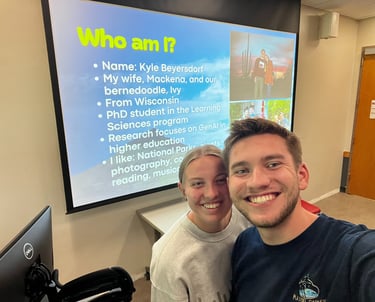
Teaching

This section shows evidence that support my teaching competency. You will find information about my teaching experience in the last few years, instructional design and development competencies, and knowledge related to college pedagogy acquired through coursework.

INSTRUCTIONAL EXPERIENCE

Learning Theories for Teachers (EDUC-I 251)

Overview: As an Associate Instructor at Indiana University Bloomington, I was the instructor-on-record for Learning Theories for Teachers to a total of 51 undergraduate students across two course sections. This course is one of four required courses for teacher education majors and it introduces foundational theories of learning in the context of school-based instruction. Over the fifteen-week semester, meeting twice weekly, I was responsible for designing and delivering all in-class instruction, assessing student work and providing meaningful feedback, and managing the course site on Canvas (the university's learning management system).

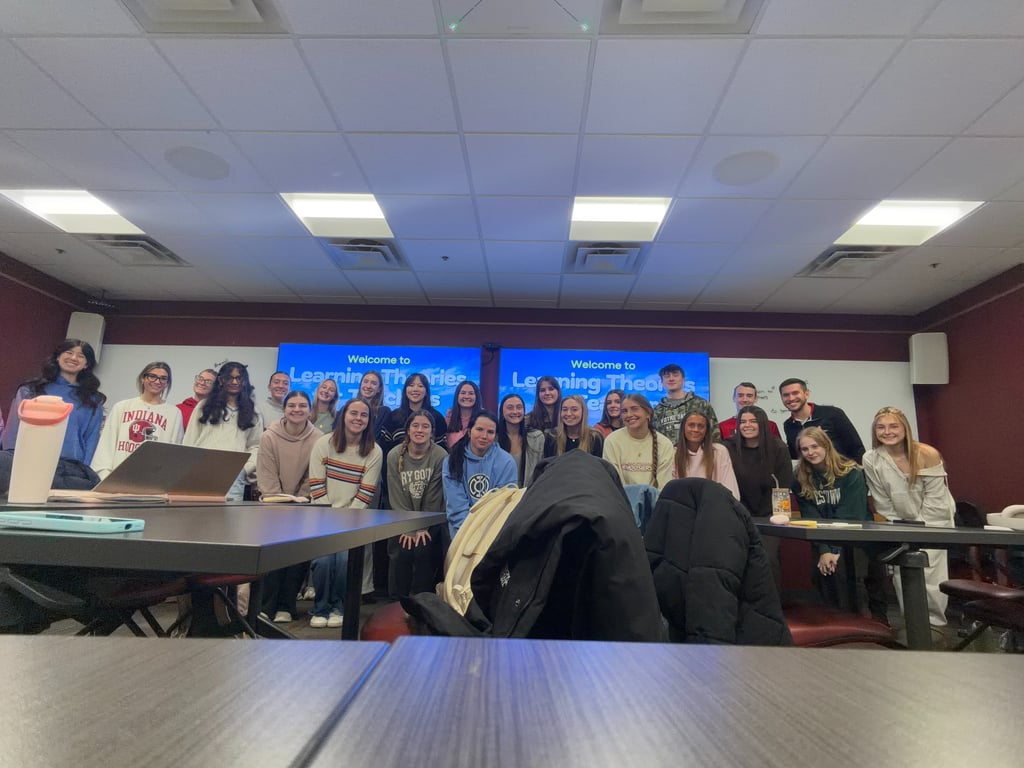
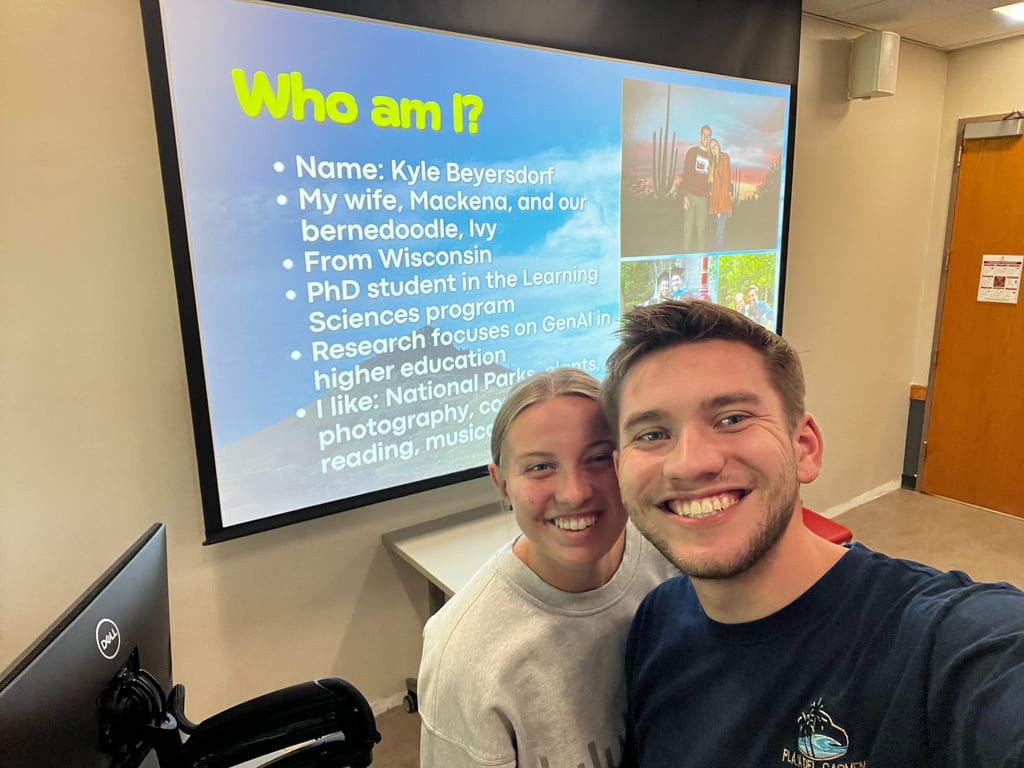
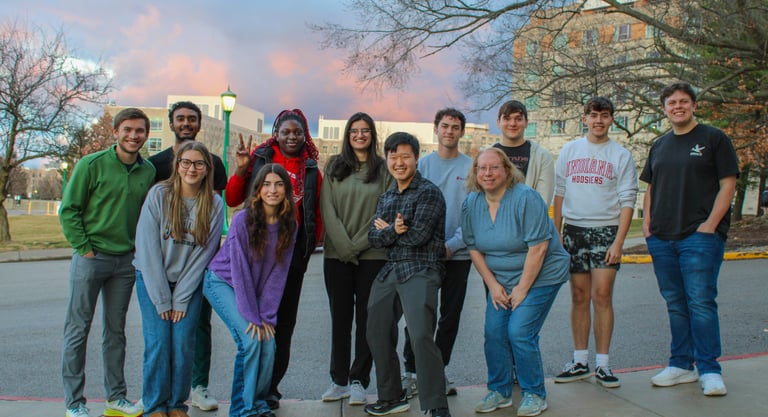
Spring 2026 Class Photograph

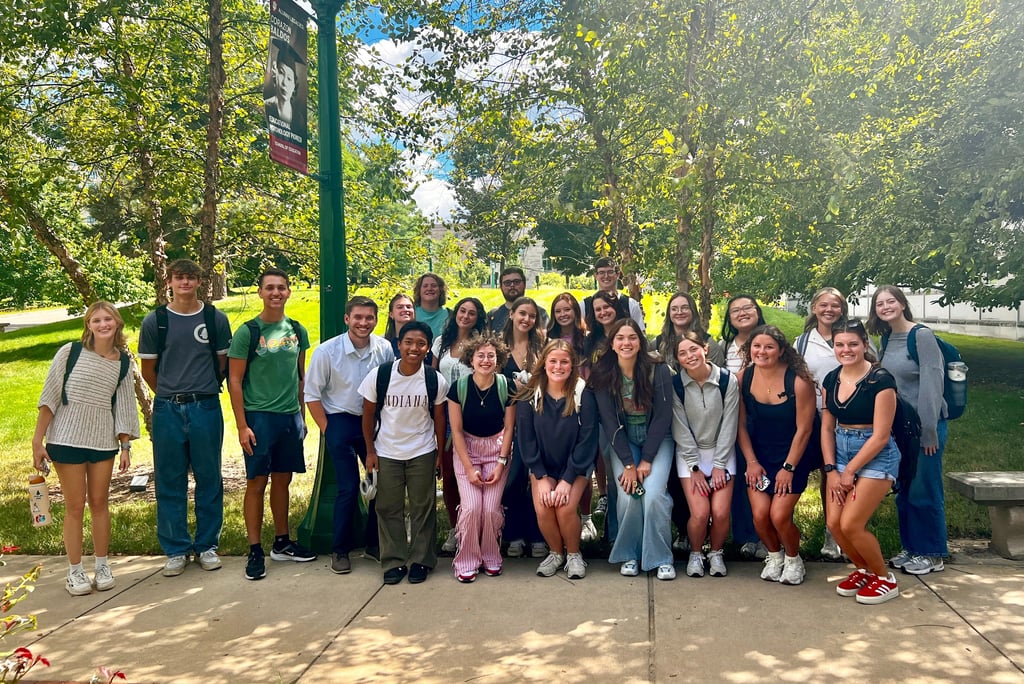
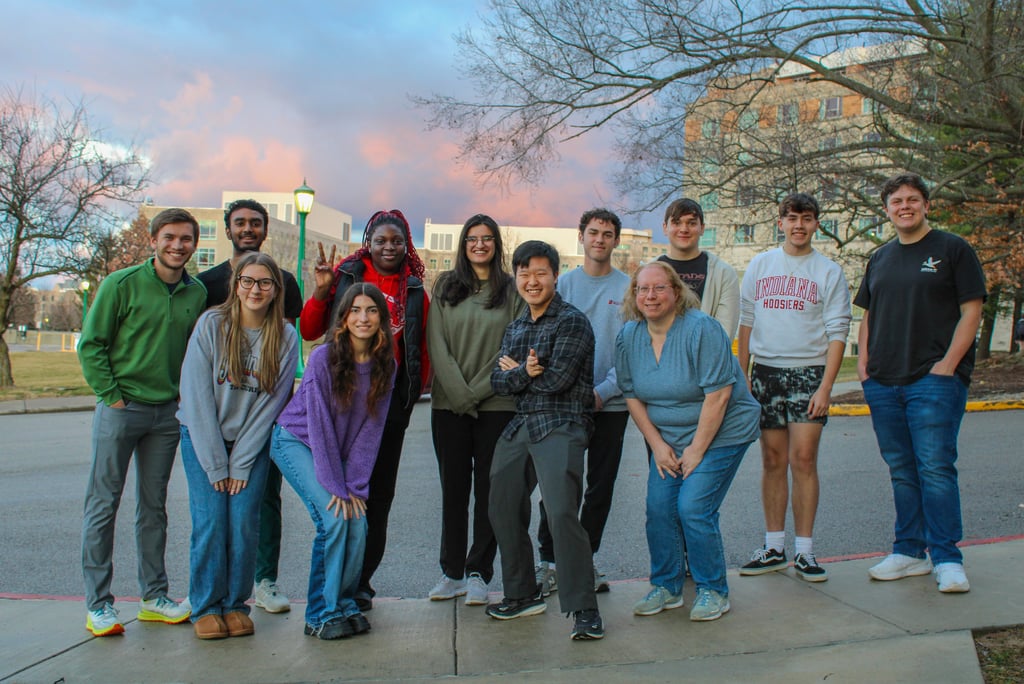
Fall 2025 Class Photograph

"Kyle designs creative, interactive class activities to make the content relevant, and then freely shares his designs and experiences with the other AIs. His "way of being" has been extremely conducive to building an atmosphere of trust and cooperation amongst the instructors!"

Dr. Susan Drumm, I251 Course Coordinator
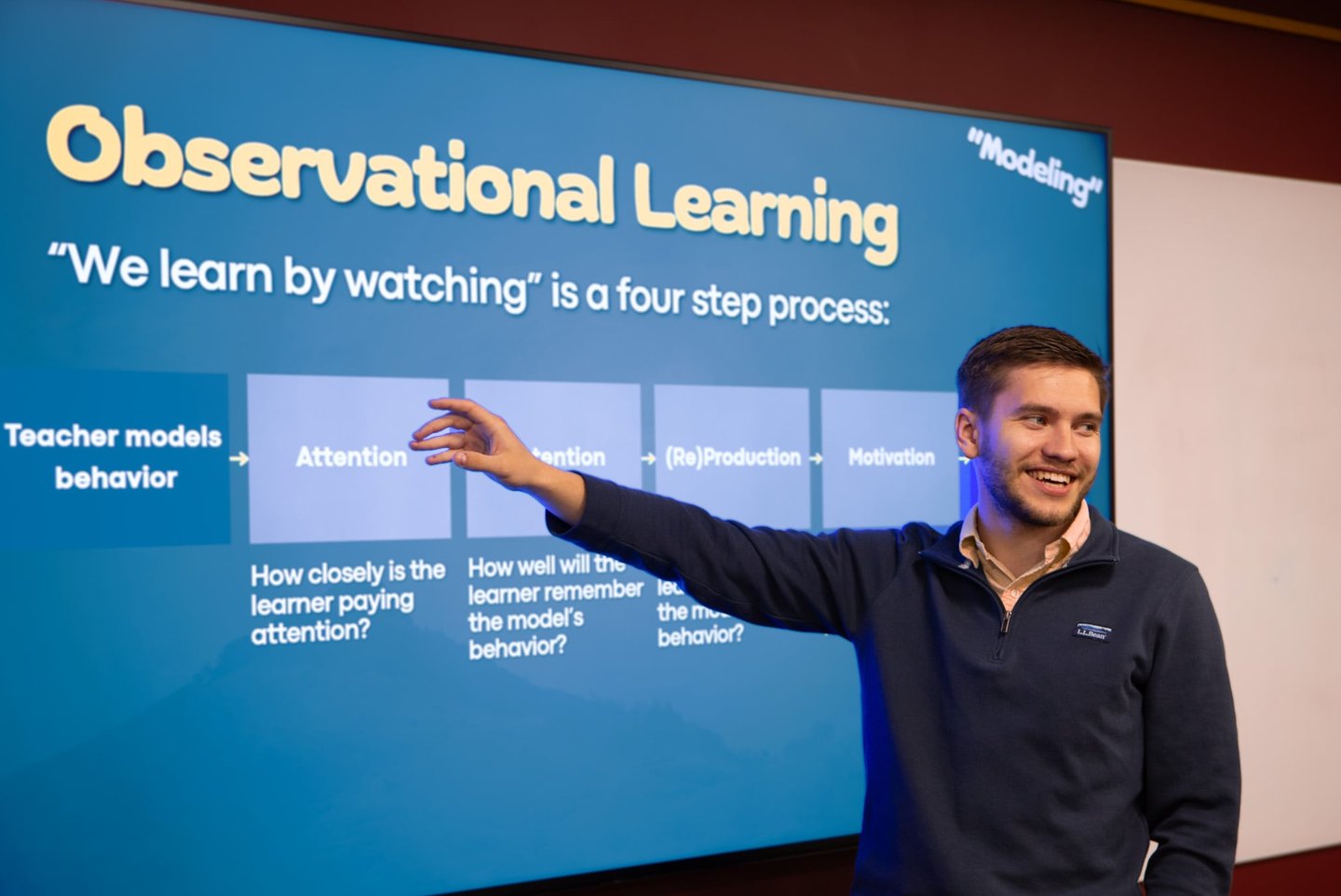
Artificial Intelligence for Learning and Life (EDUC-F 401)

Overview: I co-instructed Artificial Intelligence for Learning and Life at Indiana University Bloomington with Dr. Susan Drumm. The asynchronous, 8-week course for XX undergraduate students explored... Students were from vastly different academic disciplines from ballet to Kelley School of Business, and each sought to think of GenAI in personally relevant ways.

Artifacts to View:

Foundations of Residential Leadership (EDUC-U 450)

Overview: I co-instructed Foundations of Residential Leadership (EDUC-U450) during the spring of 2024. With 9 undergraduate students, the 2-credit, in-person course focused on student leadership, identity development, cognitive dissonance, decision-making, and community building. I was responsible for facilitating class sessions and grading student assessments.

Students provided brief quotes that at the end of the semester which demonstrated the classroom environment I strive to cultivate. For instance, Aryana said, “The questions each week were super fun, and you always find ways to include everyone.” Susie commented, “You always find a way to make people feel included. Such a kind soul.” Sid contributed, “Thank you for making everyone feel welcome, especially with your daily questions.”

My instruction during one class session was observed by Dr. Tamika Smith. In her evaluation, Dr. Smith noted, “[I] shine at asking [my] class follow-up questions, challenging them to think about things from a different perspective or in a more profound way (GREAT JOB!). [I] shared personal experiences and knowledge throughout the lesson. Overall, great job. Keep up the excellent work.”

Artifacts to View:

TEACHING & PEDAGOGICAL TRAINING

Academic Credentials

  • College Pedagogy, graduate certificate, IU

  • Learning Sciences, Media, and Technology, graduate certificate, IU

Graduate Coursework

  • Supervised College Teaching (EDUC-C 675)

  • Learning and Cognition in Education (EDUC-P 540)

  • Designing Learning for Motivation (EDUC-I 632)

  • Problem-Based Learning (EDUC-P 674)

  • Assessment and Learning (EDUC-P 507)

  • Emerging Learning Technologies (EDUC-R 678)

  • Curriculum in Higher Education (EDUC-C 750)

  • Global Perspectives on Learning Sciences and Design (EDUC-P 674)

  • Student Development Theory and Research (EDUC-U 548)

  • Diverse Students on the College Campus (EDUC-U 546)

  • Academic Problems in Higher Education (EDUC-C 695)

TEACHING PHILOSOPHY

TEACHING PHILOSOPHY

I approach teaching as a relational, design-oriented practice focused on facilitating meaningful learning rather than transmitting information. Teaching, in my view, is not the act of imparting knowledge unto students, but the intentional creation of conditions in which students actively construct understanding through discussion, application, and reflection. This stance stands in direct opposition to instructional models that position students as passive recipients of content. Instead, I see learners as capable sense-makers whose thinking deepens when they are invited into intellectually rigorous, socially supportive, and authentically situated learning environments.

Across my teaching at Indiana University–including Learning Theories for Teachers (EDUC-I251), Leveraging Artificial Intelligence for Learning and Life (EDUC-F401), Field Experience: Learning Theories (EDUC-M101), and Foundations of Residential Leadership (EDUC-U450)–I have worked to design courses that balance structure and flexibility, theory and practice, and individual reflection with collaborative sense-making.

Teaching is Relational

Learning is inseparable from the relational contexts in which it occurs. Students are more willing to engage in complex thinking when classrooms feel predictable, respectful, and psychologically safe. I therefore prioritize clear routines, transparent expectations, and participation norms that treat students' ideas as contributions to collective inquiry rather than answers to be evaluated.

Students frequently describe this design in concrete terms. One student from I251 reflected:

  • “It’s been really good! I like how the class is set up—it feels predictable, which makes me feel very comfortable. I am also extremely interested in learning theories; I find learning about them really helpful.”

Another emphasized how this environment shaped their engagement:

  • “So far, I have really enjoyed this class. It’s very open and honest and I do look forward to coming to class.”

Importantly, this sense of comfort does not replace rigor. Rather, it enables students to participate more fully in demanding intellectual work. As one student explained:

  • “I feel naturally inclined to talk a lot because I am passionate about the material. I find it interesting and enjoy collaborating with others as well.”

My goal is to design classrooms where students feel secure enough to think publicly, disagree productively, and revise their ideas–conditions that are essential for deep learning at the college level.

Facilitating Thinking Rather Than Delivering Content

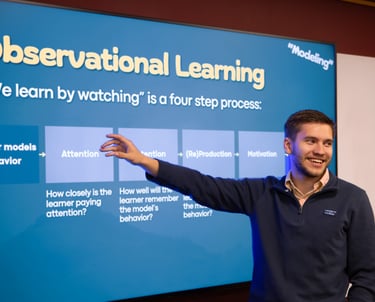
My instructional design emphasizes facilitation over coverage. Rather than centering class time on extended lectures, I structure learning around repeated cycles of engagement: brief conceptual input, collaborative sense-making, application, and reflection. A signature curricular routine that I integrated in I251 is the Learning Launch, in which a student begins each class with a short synthesis of the day's topic and questions for peers. This practice promotes ownership, primes discussion, and positions students as contributors to the learning process.

Faculty observations affirm the effectiveness of this approach. One observer noted:

  • “The class began with a student presenting a 5-minute introduction to the topic of the day, which resulted in an engaging peer learning opportunity and allowed the student presenting to exhibit some ownership over the topic as the day started. What a great way to begin.”

The same observer highlighted how content delivery was intentionally designed to support thinking:

  • “Kyle’s slides were well designed and got right to the point. He delivered content in small chunks, interspersed with several different types of questions to help students understand the material by discussing with each other how it applied to their contexts and experiences.”

Students consistently recognize this balance between structure and interaction:

  • “I have enjoyed this course and feel the ratio of discussion to activity is effective and helps keep me engaged.”

These routines reflect my belief that college classrooms should function as spaces for guided intellectual work rather than passive content consumption.

Situated Learning Through Authentic Tasks

Grounded in principles of situated cognition, I design assignments that mirror the complexity of real-world practice. In Learning Theories for Teachers (EDUC-I251), Workshops function as structured studio time rather than recitations. During workshops, students collaboratively analyze classroom videos, instructional scenarios, or professional dilemmas using learning theories as analytic tools.

Students consistently identify these workshops as central to their learning:

  • “I think that this class has been very helpful, ESPECIALLY the workshops, because this gives me time to think about the learning theories, it helps me actually use them and understand them for the video analysis.”

Another student emphasized how application supported transfer:

  • “I like how many opportunities we get to apply what we are learning in class. I definitely learn more when I am applying, and it sticks with me more when I put it into practice.”

In Field Experience: Learning Theories, this applied orientation extends beyond the classroom through Interviews in the Field, in which students speak with practicing educators and analyze those conversations through theoretical lenses. These assignments help students see theory as a tool for interpreting lived experience rather than abstract terminology.

Perspective-Taking and Inclusive Participation

A central aim of my teaching is to help students recognize that educational and leadership decisions are shaped by perspective, context, and values. I design activities that explicitly foreground perspective-taking, asking students to reason through dilemmas from the viewpoints of students, teachers, families, administrators, or community members. Randomized group work supports exposure to diverse ideas and disrupts habitual participation patterns.

Students regularly highlight the value of this collaborative design:

  • “I really like the group work, especially with random groups.”

  • “I have enjoyed working in small groups during class because it helps open my eyes to different perspectives and ideas.”

Faculty observers have noted how participation is intentionally structured:

  • “After sharing in small groups, Kyle would call on a different group each time to share out, ensuring that different voices were heard… There was a good variety of expression forms students could access to help them participate.”

Students themselves describe the effect of this inclusivity:

  • “I like how valuable our comments are even if they contribute nothing to the conversations.”

While informal in tone, this comment reflects a meaningful outcome: students perceive participation as a low-risk, intellectually valued act, which increases engagement and persistence.

Learning Beyond the Classroom

To further situate learning, I incorporate guest speakers who connect course concepts to lived professional experience. In Learning Theories for Teachers, guest sessions–including practicing educators and leaders–help students examine how theory informs real decision-making. One student reflected after a guest session:

  • “This was genuinely so cool and special. I really appreciate it—definitely my favorite day of class as an education major ever.”

These experiences reinforce the idea that knowledge is socially distributed and that college learning should connect students to broader professional communities.

Feedback, Reflection, and Pedagogical Collaboration

Feedback in my courses is formative and developmental, focused on helping students clarify thinking and identify next steps. Students frequently comment on the accessibility of support:

  • “Kyle is good at explaining things and helps when needed.”

  • “The workload is very manageable and the material is interesting.”

I apply the same reflective stance to my own teaching. I actively solicit feedback and treat my courses as sites of pedagogical experimentation. For example, while many students find end-of-class reflections useful, one student noted that “the key takeaways are a little pointless,” feedback I take seriously as I refine how reflection functions within the course.

Colleagues have described my teaching as collaborative and community-oriented. A course coordinator shared:

  • “Kyle designs creative, interactive class activities to make the content relevant, and then freely shares his designs and experiences with the other AIs. His ‘way of being’ has been extremely conducive to building an atmosphere of trust and cooperation amongst the instructors.”

This orientation reflects my belief that effective college teaching is strengthened through shared design, reflection, and dialogue among faculty.

Looking Ahead: Pedagogical Growth

In the next several years, I aim to continue challenging myself as a college instructor by treating my courses as sites of ongoing pedagogical inquiry rather than fixed instructional products. In EDUC-I-251, I plan to refine the Workshop model by adding scaffolds that support deeper theoretical comparison and critique. In EDUC-M101, I hope to strengthen cross-case analysis in Interviews in the Field to help students identify patterns across educational contexts. In EDUC-F401, my focus is on helping students develop more critical and ethical orientations toward emerging technologies through structured design challenges. In EDUC-U450, I plan to deepen leadership simulations and longitudinal reflection on identity development.

Across all courses, I am particularly interested in examining how routines such as the Learning Launch, randomized group work, and multimodal reflection shape students’ willingness to participate, revise their thinking, and see themselves as capable learners. I view teaching as a practice that is never complete, but continually responsive—to theory, to evidence, and to the students in the room.

My goal as a college instructor is not simply for students to learn content, but for them to leave my courses thinking differently about learning, teaching, leadership, and their own capacity to grow. By designing relational, structured, and authentically grounded learning environments, I aim to support students in developing habits of mind that extend beyond a single course. Teaching, for me, is the ongoing work of designing and refining conditions under which meaningful learning can occur—guided by theory, informed by evidence, and sustained through collaboration.