Research
In this section, you will find evidence that showcases how I have developed my research competencies. This includes information regarding my first authored study, the research groups I have worked with, other publications and conference presentations, and academic credentials.
FIRST AUTHORED STUDY
Title: Who Engages in Interdisciplinary Teaching and Research?: An Analysis of Faculty Characteristics and Institutional Context
Abstract: Interdisciplinary teaching and research are increasingly valued in higher education, yet faculty participation in these practices varies widely. This study quantitatively examines the extent to which professional, personal, and institutional characteristics shape faculty engagement in interdisciplinary teaching and research across U.S. higher education institutions. Specifically, it investigates how faculty rank, tenure status, gender, and race/ethnicity relate to interdisciplinary engagement, as well as how institutional characteristics such as institutional type and faculty appointment structure influence these practices. This study draws on 1,701 faculty responses from 26 institutions participating in the 2025 Faculty Survey of Student Engagement (FSSE). Using regression analysis, it first estimates the influence of individual faculty characteristics on interdisciplinary engagement and then models the additive and interactive effects of institutional context. By distinguishing identity-based and context-based predictors, the study offers a nuanced understanding of who engages in interdisciplinary work and under what conditions. Findings aim to inform institutional policy and support structures that may expand equitable participation in interdisciplinary teaching and research across higher education.
Artifacts to View
RESEARCH GROUPS
National Survey of Student Engagement
NSSE
NSSE annually collects information at hundreds of four-year colleges and universities about first-year and senior students' participation in programs and activities that institutions provide for their learning and personal development. The results provide an estimate of how undergraduates spend their time and what they gain from attending college. I contributed directly to the drafting of the items focused on generative AI that would appear on the survey and will present data findings at the Association for Institutional Research (AIR) national conference.
Participatory Learning and Assessment
Dr. Hickey's Lab
Dr. Hickey's research lab is focused on expansive framing, productive disciplinary engagement, motivation, cybersecurity, and other relevant and related scholarly work. I am currently involved in a large-scale systematic review focused on expansive framing's five explanations (Engle, 2002), most specifically with coding for relevant articles.
Faculty Survey of Student Engagement
FSSE
FSSE is a national, large-scale survey administered at four-year colleges and universities. It specifically examines faculty teaching practices and contributions to undergraduate learning. It distributes its national survey each year and serves as a representative sample of faculty practices. I contributed directly to the drafting of the items focused on generative AI that would appear on the survey. I've also been studying the data on disciplinary cultures and interdisciplinary practices with hopes of forthcoming publications.
GLOBAL RESEARCH EXPERIENCE
I am the first School of Education student ever selected to participate in the UNFCCC Conference of Parties (COP31) as an IU delegate. In November 2026, I will travel to Antalya, Türkiye, to conduct an ethnographic study to examine higher education's role in advancing global climate justice. This interdisciplinary experience will extend my broader scholarly and pedagogical commitment to bridging theory and practice, particularly in how learning and knowledge systems operate across institutional and global contexts. By situating myself within this global policy environment, I aim to better understand how educational institutions can more effectively prepare learners to navigate and shape urgent societal challenges.
LITERATURE REVIEWS & STUDIES
Provide a short summary of your recent projects, highlighting the most important things.
AI Podcasts
Title: Preservice Teachers’ Motivation and Praxis with NotebookLM Podcasts in a Learning Theories Course
Overview: This study examined how preservice teachers experience “AI podcasts” created with Google NotebookLM’s Audio Overview. Grounded in Situated Expectancy-Value Theory, the study investigated students’ perceived value (intrinsic, utility, attainment) and cost of engaging with AI podcasts in relation to their perceived support for praxis (connecting theory to future classroom practice), and comparisons with traditional readings. Both a survey and interviews were used after exposure to eight AI podcasts. Thematic analysis from the pilot study suggested podcasts increased intrinsic value by aligning with students’ everyday media habits and reducing stress; increased utility value by improving comprehension, supporting class preparation, and saving time; and supported attainment value by strengthening confidence and teacher-identity alignment.
Project title
Title: TBD
Overview: Text
PUBLICATIONS
The Currency of Higher Education
Title: Understanding the Credit Hour as the Currency of Higher Education
Full Reference: Ely, M., & Beyersdorf, K. (revise & resubmit). Understanding the credit hour as the currency of higher education. In K. J. Bazner & D. C. J. Catalano (Eds.), Historical thinking for higher education leadership: Putting the past in practice. Routledge.
Generative Learning with Expansive Framing
Title: Fostering Generative Learning with Expansive Framing: A Systematic Review
Full Reference: Beyersdorf, K., Hickey, D. T., & Freedman, E. (in preparation). Fostering generative learning with expansive framing: A systematic review.
Faculty Adoption of GenAI
Title: Mapping Faculty Engagement with Generative AI: A Typology of Adoption Patterns in Higher Education
Full Reference: Beyersdorf, K., Sheng, J., Jin, S., & BrckaLorenz, A. (in preparation). Mapping faculty engagement with generative AI: A typology of adoption patterns in higher education.
Let's Get Ethical with GenAI
Title: Let’s Get Ethical: An Exploration of Undergraduate Decision Making Regarding the Use of Generative Artificial Intelligence
Full Reference: Beyersdorf, K., Klee, S., & Mántica, M. G. (2025). Let's get ethical: An exploration of undergraduate decision making regarding the use of generative artificial intelligence. Journal of the Student Personnel Association at Indiana University, 52, 68-89.
Overview: This study explored undergraduate students’ perceptions and beliefs regarding the ethical use of GenAI in academic work. Specifically, it addressed two research questions:
How do IUB undergraduate students define the ethical use of GenAI in their academic work?
What factors influence students' decisions to use GenAI?
As researchers we sought to grasp the motivations behind students' use of GenAI to establish shared expectations for ethical AI use and the situations it is deemed appropriate by students. Grounded in Rest’s Four Component Model of Moral Decision Making, this study employed an open-ended qualitative survey distributed across the IU Bloomington campus and collected 117 student responses. Thematic analysis of the narrative survey responses revealed that although a significant proportion of students utilize GenAI tools, their usage is primarily influenced by a desire to enhance understanding, generate ideas, and refine their work. Students generally associate ethical usage when utilizing GenAI as an assistive resource, whereas outsourcing entire assignments through the use of GenAI is deemed inappropriate and counterproductive to learning. Factors influencing students' decisions to use or avoid GenAI include authority figures, policies, assignment characteristics, and personal beliefs–highlighting the need for clear, communicated guidelines around GenAI usage.
Artifacts to View
Problem-Focused Programs
Title: Reimagining Higher Education Curricula for Societal Impact: Problem-Focused Programs
Full Reference: Beyersdorf, K. (2025). Reimagining higher education curricula for societal impact: Problem-focused programs. Journal of the Student Personnel Association at Indiana University, 52, 1-7.
Artifacts to View
PAPER PRESENTATIONS
Vickery, M., Bai, E., Beyersdorf, K., Sheng, J., Desai, A., & Chakraburty, S. (2026, June). Where do I start? A tool for interactive literature discovery in the learning sciences. International Society of the Learning Sciences Conference, Irvine, CA.
Gonyea, B., Gumford, A., Awan, M., & Beyersdorf, K. (2026, May). Generative AI and engagement: Insights from a multi-institution survey. Association for Institutional Research Annual Forum, Washington, DC.
Hiller, S. C., Nelson Laird, T. F., Braught, E., & Beyersdorf, K. (2026, April). Beyond disciplinary boundaries: How interdisciplinary teaching relates to faculty pedagogical practices across disciplinary contexts. American Educational Research Association Annual Meeting, Los Angeles, CA.
Beyersdorf, K. (2026, March). Preservice teachers’ motivation and praxis with NotebookLM podcasts in a learning theories course. Graduates in Instructional Systems and Technology Conference, Bloomington, IN.
Hickey, D. T., & Beyersdorf, K. (2025, October). Personally authentic generative AI for engagement, assessment, and transfer. Indiana Connected Educators, Bloomington, IN.
Hickey, D. T., & Beyersdorf, K. (2025, October). Culturally responsive and personally authentic assessment with generative AI. Assessment Institute, Indianapolis, IN.
CONFERENCE PRESENTATIONS
Beyersdorf, K., Klee, S., & Mántica, M. G. (2025, April). Let’s get ethical: An exploration of undergraduate decision making regarding the use of generative artificial intelligence. Plater-Moore Conference on Teaching and Learning, Indianapolis, IN.
Beyersdorf, K., Klee, S., & Mántica, M. G. (2025, March). Let’s get ethical: An exploration of undergraduate decision making regarding the use of generative artificial intelligence. Annual Graduate Student Education Research Symposium, West Lafayette, IN. *Awarded 2nd place poster presentation*
Beyersdorf, K., Klee, S., & Mántica, M. G. (2024, December). Let’s get ethical: An exploration of undergraduate decision making regarding the use of generative artificial intelligence. HESA Master’s Students Research Exhibition, Bloomington, IN.
Beyersdorf, K., & King, K. (2023, November). Undergraduate adult learners in college. HESA Master’s Students Research Exhibition, Bloomington, IN.
Beyersdorf, K. (2023, May). The forgotten architects of sporting mega-events: Remembering the World Cup in Qatar 2022 as synonymous with migrant worker exploitation and abuse. College of Letters and Science Undergraduate Research Symposium, Stevens Point, WI.
Beyersdorf, K. (2023, March). The fight to tell history: Battles over the national history standards in the 1990s. Research in the Rotunda, Madison, WI.
Beyersdorf, K. (2022, May). A jump or a hurdle: The ‘push’ factors for Latin American immigrants. College of Letters and Science Undergraduate Research Symposium, Stevens Point, WI.
Beyersdorf, K. (2022, March). A jump or a hurdle: The ‘push’ factors for Latin American immigrants. Research in the Rotunda, Madison, WI.
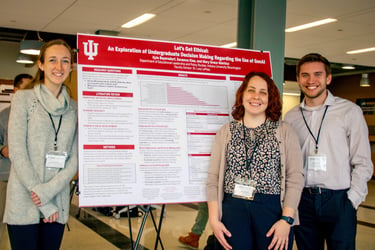
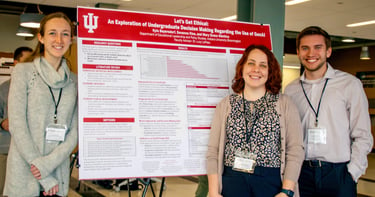
Purdue's Graduate Student Education Research Symposium (2025), West Lafayette, Indiana, with Savanna Klee and Mary Grace Mántica.
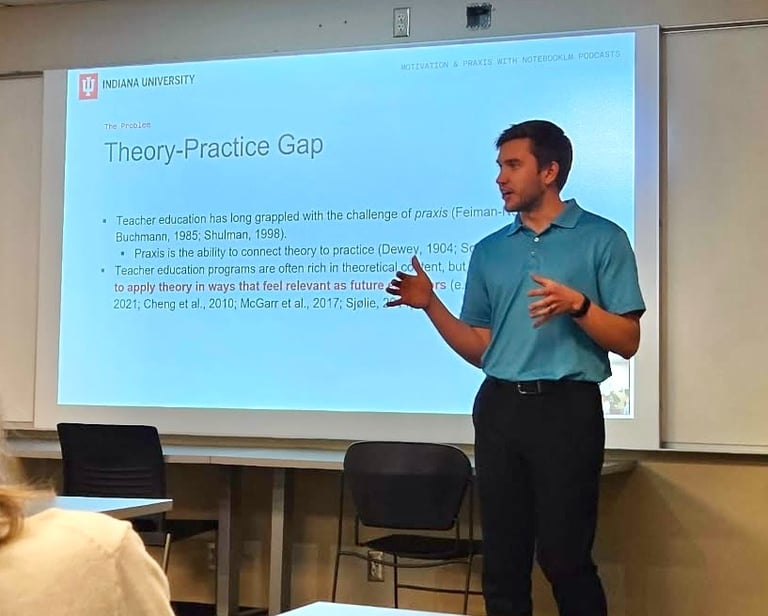
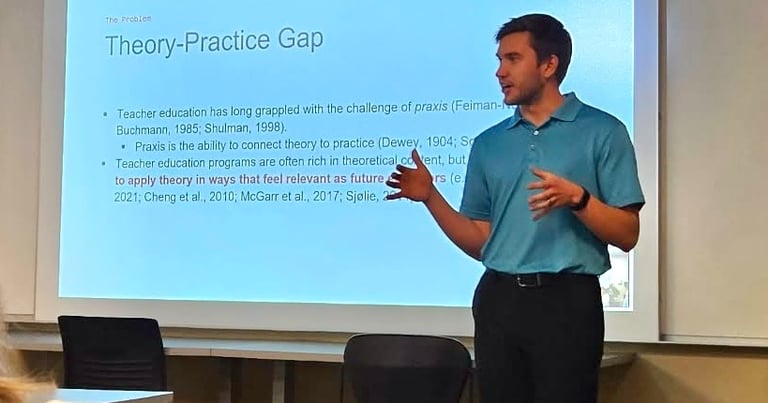
Graduates in Instructional Systems and Technology Conference (2026), Bloomington, Indiana.
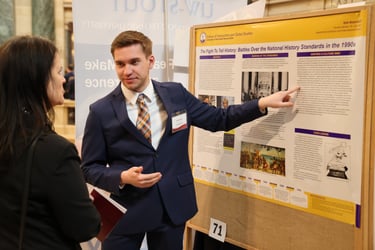
Research in the Rotunda (2023), Madison, Wisconsin, with former UWSP Provost Dr. La Vonne Cornell-Swanson.
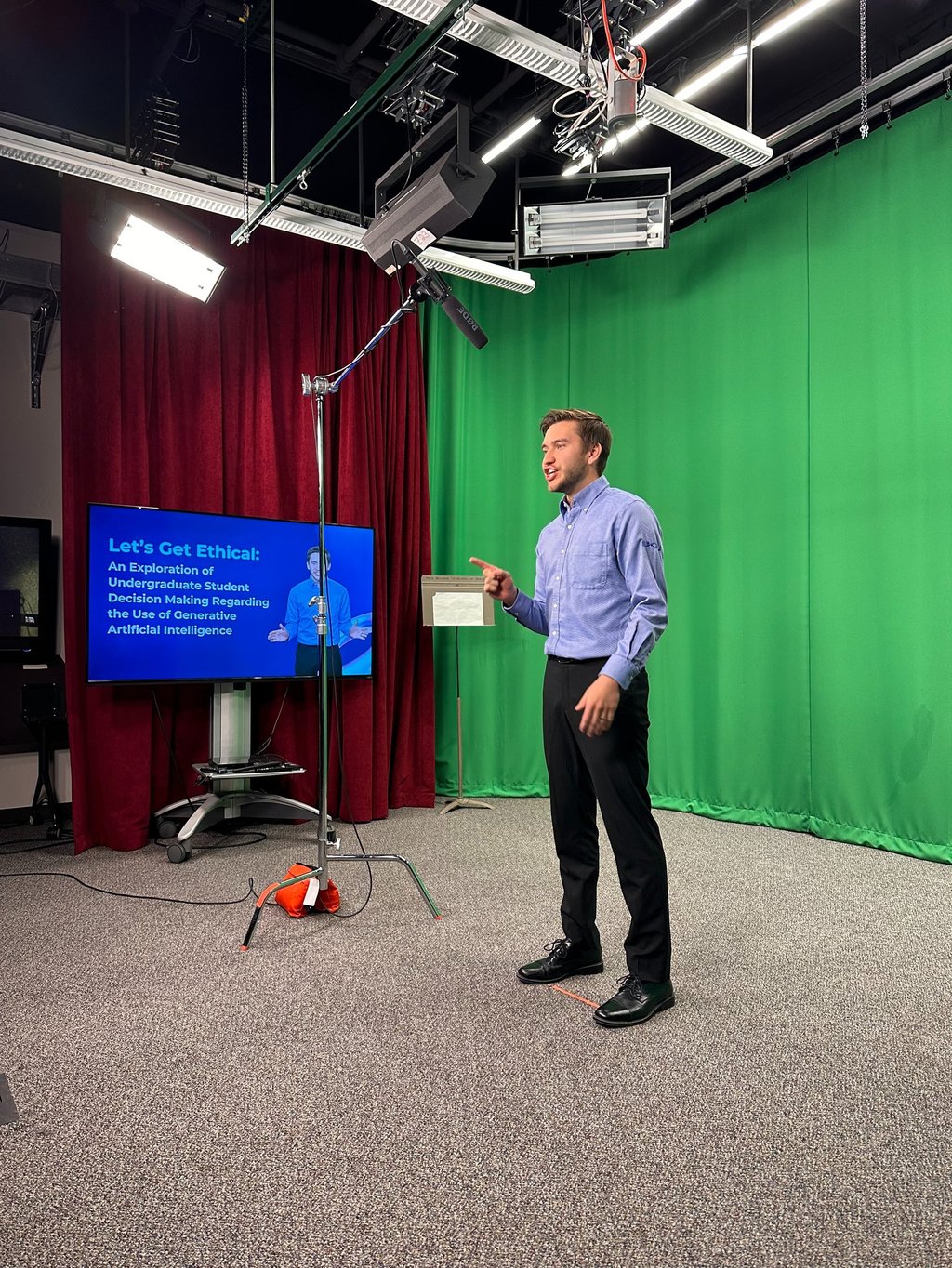
Filming a recorded research presentation in the IU School of Education.
RESEARCH TRAINING & COURSEWORK
Academic Credentials
Institutional Research, graduate certificate, IU
Social and Behavioral Responsible Conduct of Research, CITI Program
Graduate Coursework
Strategies for Educational Inquiry (EDUC-Y 520), summer '24
Intermediate Statistics Applied to Education (EDUC-Y 502), summer '25
Qualitative Inquiry (EDUC-Y 611), fall '25
Mixed Methods Research (EDUC-Y 641), spring '26
Design-Based Research (EDUC-I 633), fall '26
Research Practice Partnership with Community Collaboration (EDUC-I 674), fall '25
Environmental Theory and Assessment (EDUC-U 549), fall '24
Foundations of Institutional Research (EDUC-C 661), spring '25
Capstone in Institutional Research (EDUC-C 678), summer '26
RESEARCH SUPERVISION
With the IU School of Medicine, I advised six medical students on community-engaged research projects as part of this co-curricular, grant-funded AmeriCorps program. This experience emphasized culturally responsive healthcare practices and guided students in developing skills for addressing health disparities, fostering a comprehensive approach to medical education. Each students' summer experience culminated in a research project that was presented at the Indiana University Medical Student Program for Research and Scholarship (IMPRS) Summer Research Program Poster Symposium. I was privileged to support and directly advise the following six students' in their research experience:
Blakely, M., Alexis, M., & Messmore, N. (July 2024). Mental health literacy assessment among Black girls ages 6-16 [poster presentation]. IMPRS Research Symposium. Indianapolis, IN.
Blango, M., Messmore, N., & Beyersdorf, K. (July 2024). Understanding the impact of secondary trauma: A quick review [poster presentation]. IMPRS Poster Symposium. Indianapolis, IN.
Castillo, S., Alexis, M., & Messmore, N. (July 2024). Assessing child sexual abuse preventative education programs and factors of disclosure rates [poster presentation]. IMPRS Research Symposium. Indianapolis, IN.
McEvilly, T., & Messmore, N. (July 2024). The efficacy of an FQHC’s homeless initiative program in reducing emergency department recidivism for unhoused populations [poster presentation]. IMPRS Research Symposium. Indianapolis, IN.
Reyes, B., & Messmore, N. (July 2024). Surveying HPV vaccination status and identifying barriers within the Burmese community in Indianapolis [poster presentation]. IMPRS Research Symposium. Indianapolis, IN.
Singh, K., & Messmore, N. (July 2024). Social connectedness and its importance on mental health in the elderly population [poster presentation]. IMPRS Research Symposium. Indianapolis, IN.
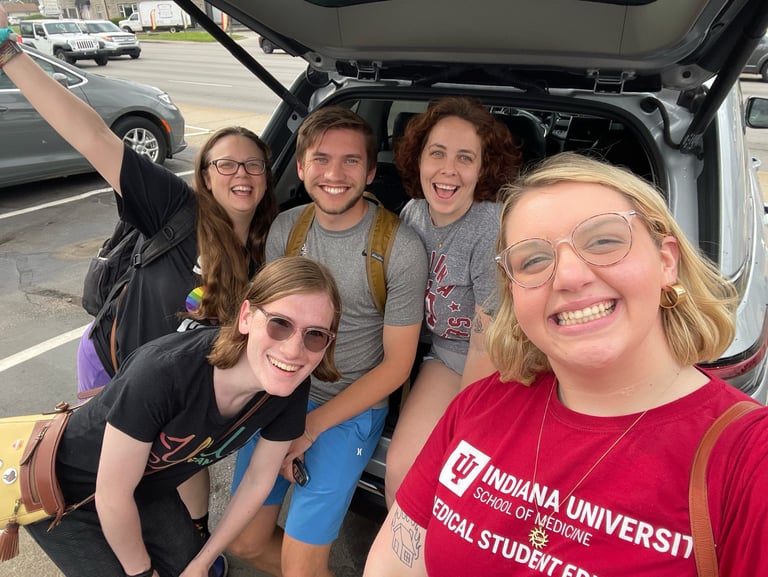
Hoosier Public Health Corps (HPHC) Summer Intern team (2025), including Niki Messmore, Katelyn King, Mary Grace Mántica, and Savanna Gray (L-R).
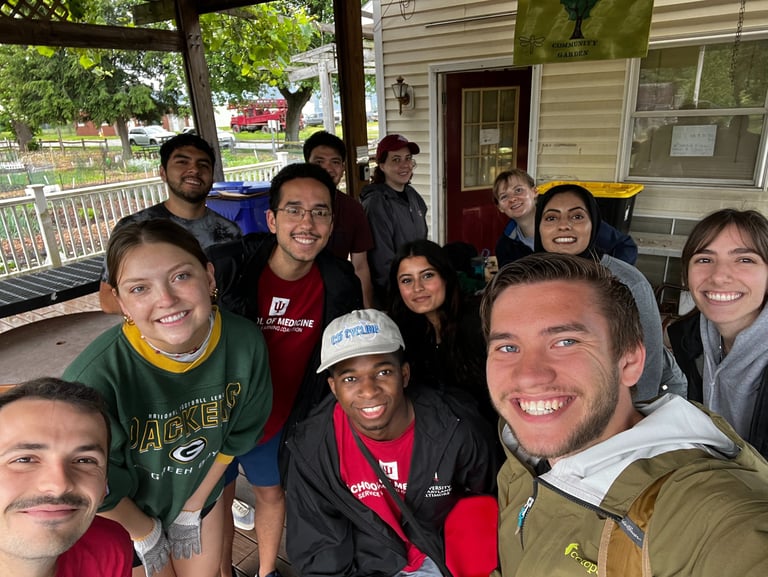
Part of the Hoosier Public Health Corps (HPHC) cohort of IU School of Medicine students at the community garden clean up service day.